

Picture yourself on a summer evening, sharing a glass of wine on a sunlit terrace. What if this wine, beyond its aromas, carried a promise? That of a living soil, a preserved vine, a farming gesture that respects the planet and our health. Welcome to the world of organic wine.
Increasingly sought after, organic wine keeps gaining ground in our glasses. But what really lies behind this reassuring green label? Between environmental commitment, technical constraints and the pleasure of authentic taste, let us explore a world where wine takes root in eco-responsible production.
What is an organic wine? A committed definition
Since 2012, European regulation has strictly framed organic viticulture and the making of certified organic wines. In practice, an organic wine must meet a strict set of specifications covering its whole production.
In the vineyard
- No trace of pesticides or synthetic chemical products;
- Only natural treatments such as sulphur, copper or plant extracts;
- Enriching the soil with organic compost;
- Respect for biodiversity through hedges, nesting boxes, ground cover and so on.
In the cellar
- Grapes 100% from organic farming;
- Natural winemaking techniques, with limited oenological additives;
- Limited sulfites, sometimes absent;
- Priority to native yeasts, true fingerprints of the terroir.
Organic conversion: a path full of hurdles, and hope
Becoming an organic grower is not only about changing practices. It means rethinking a whole philosophy of farming. And it starts with a three-year conversion, during which the producer follows organic rules without yet being able to use the label.
During this period, the risks are many:
- A drop in yield due to stopping conventional treatments;
- Increased watchfulness against disease;
- The need for more labour for hand harvesting or mechanical weeding.
But the reward matches the effort: the organic certification, granted after regular checks, is a mark of seriousness, traceability and trust for the consumer.
Aromas truer than nature
One of the major appeals of organic wine is its taste quality. Enthusiasts often speak of an authentic taste, of more “vibrant” wines with a better expression of terroir.
Why? Because a living soil, not saturated with chemical fertilisers, feeds the vine better. The result: grape varieties that fully express their character, franker aromas, a marked typicity. And when the approach is pushed to biodynamic or natural wine, the profiles become even more singular, sometimes disconcerting, but always alive.
Consumed in moderation, wine can be good for the heart, and an organic wine potentially more so. Here is why:
- Fewer or no pesticide residues;
- Limited sulfites, reducing the risk of allergies or headaches;
- Rich in antioxidants (polyphenols, resveratrol), naturally present in the grape.
A gesture for oneself, but also for the planet. Each bottle of organic wine means less pollution of groundwater, more preservation of natural resources and a reduced impact on the environment.
The constraints of a demanding commitment
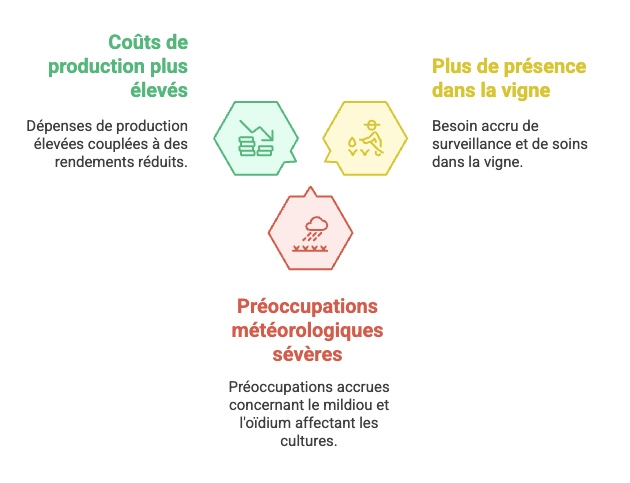
You do not make organic wine to save time. Organic viticulture means:
- More presence in the vineyard;
- Weather feared like never before (downy mildew, powdery mildew);
- Higher production costs, with lower yields.
Not to mention the jungle of organic labels: AB, Euroleaf, Demeter, Biodyvin. Each certification has its own features and extra requirements, especially in biodynamics. And yet, despite these challenges, more and more estates make the leap towards eco-responsible production, driven by growing demand.
Bordeaux, a prestigious terroir but a tough climate for organic
When organic wine comes up, Bordeaux does not always spring to mind. The reason: the region, one of the most famous in the world, faces particularly complex climatic conditions for organic viticulture.
The near-constant humidity, mild springs followed by stormy summers, are the ideal cocktail for the spread of downy mildew and powdery mildew. Two dreaded fungal diseases which, in conventional farming, are treated effectively with synthetic chemicals. In organic, growers can only rely on natural substances such as sulphur and copper, whose use is strictly limited by regulation. A single prolonged spell of rain can therefore threaten a whole harvest, making yields very uncertain.
In Bordeaux, land is expensive. Every cultivated hectare must “produce”, sometimes at the expense of taking risks. Organic conversion, with its high costs and climatic uncertainty, can look like a dangerous gamble for some growers. The situation is changing, though: more and more Bordeaux estates, notably in Côtes-de-Bourg, Fronsac or Graves, are converting to organic or adopting biodynamic practices.
Organic, but not without consequences: when soils tire too
It would be tempting to believe that organic viticulture, by banning synthetic chemicals, automatically guarantees healthy soils. But the reality is more complex.
In organic farming, herbicides are replaced by mechanical weeding: undervine blades, hoes, rotary harrows. The problem? These tools, passed several times a season (sometimes 6 to 10 times a year), compartmentalise the soil, dry it out, destroy some microfauna and compact the surface horizons. The result is a less aerated, less living soil, sometimes even prone to erosion, especially on slopes. In Bordeaux, on clay soils, poorly managed mechanical work can create a crust that blocks water infiltration.
Copper, allowed in organic as a natural fungicide against downy mildew, is another sensitive subject. Although mineral in origin, it is toxic to earthworms and beneficial fungi, and it accumulates in the soil without breaking down.
Fortunately, many growers aware of these effects are renewing their approach: sowing green manures, regular organic compost, fewer mechanical passes replaced by mulching or grazing (sheep in the vines), and close observation of the signs of a living soil. In short, going organic is not enough: you have to do intelligent organic, reconciling biodiversity, microbiology and restraint. This is where biodynamics and agroecological approaches can offer complementary solutions.
The organic wine market in full swing
The organic wine market keeps expanding. In France, nearly 20% of the vineyard is farmed organically or in conversion, and the trend is strengthening with consumer expectations: sensitive to environmental impact, seeking healthier products, and curious to discover wines that tell a story. Countries such as Germany, Sweden and Japan are also great lovers of French organic wine, proof that the approach shines well beyond our borders.
Organic wine embodies a sincere wish to produce differently: without synthetic pesticides, with respect for nature, the consumer and the terroir. But it is not a miracle solution. Organic, especially in a difficult region like Bordeaux, still faces real agronomic constraints: an unstable climate, soil fatigue, the controversial use of copper and sometimes heavy mechanisation. Alternatives such as biodynamics, agroforestry and reasoned, regenerative approaches can also contribute to a more sustainable viticulture, without locking into a single label.
Château d’Arsac, in the Margaux appellation, shares this attention to the vine, the soil and the Médoc landscape.