
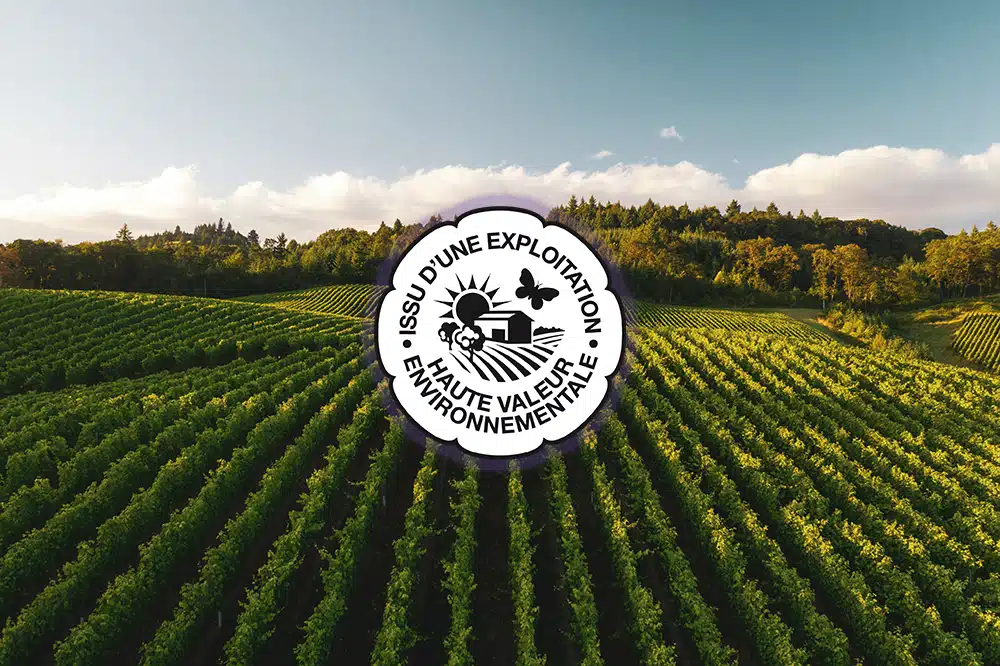
The HVE logo appears on a growing number of bottles, and it is often confused with the organic label. High Environmental Value is in fact a different scheme, overseen by the French state. It certifies the way a farm manages its environment, from biodiversity to water. Understanding what it guarantees avoids misunderstandings when choosing a bottle. This article explains what HVE is, its four pillars, how it differs from organic and its real weight in French agriculture.
What is HVE?
High Environmental Value is the third and highest level of the environmental certification of farms. It was created in 2012, following the Grenelle de l’environnement, and it is overseen by the National Commission for Environmental Certification.
The certificate is granted for three years by an independent inspection body, accredited by the ministry in charge of agriculture. It covers the entire farm, not a single product.
The four pillars of the certification
HVE is based on an obligation of results, measured by environmental performance indicators. Four themes structure the approach.
- ● Biodiversity: keeping hedges, trees and areas favourable to wildlife and plant life.
- ● Plant protection products: a measured reduction in their use.
- ● Fertilisation: reasoned management of inputs to limit excess.
- ● Water resource: economical management of irrigation and withdrawals.
HVE and organic: what is the difference?
The two schemes do not overlap. The organic label rests on a set of specifications that bans synthetic inputs and certifies a production method, product by product.
HVE, on the other hand, assesses the overall environmental performance of the whole farm, without banning those same inputs. An estate can be HVE without being organic, or combine both approaches.
HVE in figures
The certification has grown strongly, especially in vineyards. On 1 January 2024, France counted 38,351 farms certified High Environmental Value, or 9.2% of the country’s farms, covering nearly 2.3 million hectares.
Frequently asked questions
Is HVE the same as organic?
No. Organic bans synthetic inputs and certifies a product. HVE measures the overall environmental performance of the farm, without banning those inputs.
What does the HVE logo guarantee?
It guarantees a certified environmental approach across the whole farm, built on four pillars: biodiversity, plant protection products, fertilisation and water management.
How long is the certification valid?
The HVE certificate is granted for three years by an independent body accredited by the ministry in charge of agriculture.
Going further
HVE is part of a wider movement of vineyards that pay attention to the environment. Our articles on organic wines and on biodynamics shed light on the other approaches available in the vineyard.
Château d’Arsac, in the Margaux appellation, tends its vines with the same attention to living soils and to the Médoc landscape.