
Tasting is a sensory symbiosis between sight, smell, taste and even touch. The famous 4S method:
- See
- Swirl
- Sniff
- Sip
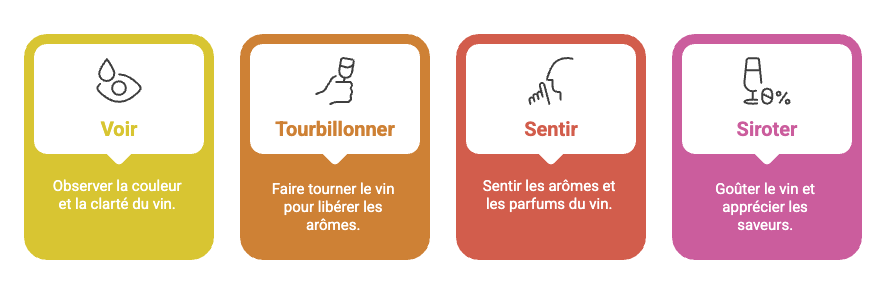
This method reveals the essence of a wine, its complexity, its balance and its length on the palate. Through this exploration, you activate physical and emotional sensations and build a personal sensory language.
Equipment matters: a springboard for your senses
Make no mistake: the use of the right glasses, like the temperature and aeration of your wine, all shape its qualities, its aromas and your sensations.
The right glasses
A tulip glass concentrates the aromas and releases them on the swirl. Beware of fancy glasses: transparency, a stem and a neutral shape stimulate your senses without biasing them.
Temperature and aeration
Serving a wine too cold hides its structure; too warm, and the alcohol dominates. Use decanting or controlled aeration to let the wine open up, especially young reds.
The sensory journey: see, smell, taste, feel
See: the first impression
- Observe the colour, the clarity, the density.
- Tilt the glass to see the robe and spot any faults. These visual clues immerse your mind in the wine’s story.
Smell: coaxing out the aromas
- First approach: a still nose, smelling the primary aromas (fruit, flowers).
- After the swirl: capture the secondary aromas (fermentation) and tertiary ones (evolution). Use the aroma wheel to enrich your vocabulary.
Taste: bringing out the complexity
- Draw in a little air to oxygenate the wine in your mouth: the aromas amplify.
- Explore sweet, salty, sour, bitter, umami, the texture, the body, the length.
- Note the trigeminal sensation: the warmth of alcohol, tannins, freshness.
Feel: emotions and memories
A wine can stir an emotion or a memory. These subjective perceptions enrich your relationship with wine: a personal emotional map takes shape.
Wondering how to improve your tasting skills?
1. Comparative tasting: sharpen your eye and palate
Comparative tasting means alternating between two close wines, by grape, region or style, to sharpen your perception. Tasting several wines side by side trains your brain to tell apart subtle aromatic details.
- Run a triangle test: two identical glasses of one wine, a third that is different. The goal? Identify the odd glass, an excellent exercise for subtle discrimination.
- A horizontal flight (same vintage of a grape) or a regional one (same grape, different regions) reveals the nuances of terroir or winemaking.
- Comparative tastings also help you discover your own preferences by noting differences in body, tannic structure or length.
2. The impact of food: test with and without a dish
Doing the same tasting before and after a dish helps you understand how the taste components interact:
- A dry wine can seem rounder after a fatty dish; a tannic red can be softened by proteins.
- This contrast reveals the influence of the meal’s sweetness, acidity or saltiness on your perceptions, and refines your food-and-wine pairing.
3. Active tasting notes: capturing the moment
Taking immediate notes (unfiltered) helps structure your sensory memory:
- Record aromas, impressions, tactile sensations and the palate; the act of writing strengthens cognitive integration.
- Coming back to these notes a day later activates the lasting memory: you will sometimes find new nuances missed in the moment.
- You will notice progress in the quality and richness of your observations.
4. Sharing and exchange: collective learning
Drinking alone is fine, but tasting together is better:
- Group tastings encourage exchange, enrich your sensory vocabulary and are recognised as a key tool for progress.
- Daring to explain why a wine evokes a sensation, an emotion or a memory develops your analytical skills: sharing your impressions means coaching your own palate.
5. Rhythm and pauses: preserving sensitivity
During a session, your attention and senses tire:
- Limit yourself to 5–6 wines per session, alternating with water, neutral bread or crackers to cleanse the palate.
- Take regular breaks: sensory saturation dulls finesse and distorts perception.
In short, you will refine your tasting experience by combining targeted comparisons (triangle, horizontal, regional), pairings and clashes (with or without food), dynamic notes (immediate then reassessed), collective feedback (in a group, with justification) and a measured rhythm (a limited number of wines, mandatory breaks).
The sensory experience is the art of travelling inside a wine. With the right equipment, methodical practice and openness to sharing, you turn every sip into a moment of emotion, discovery and connection.
Start now: prepare your tasting space, choose two wines, follow the 4S, note everything. Discover the wines of Château d’Arsac, in the Margaux appellation, to put it into practice.